
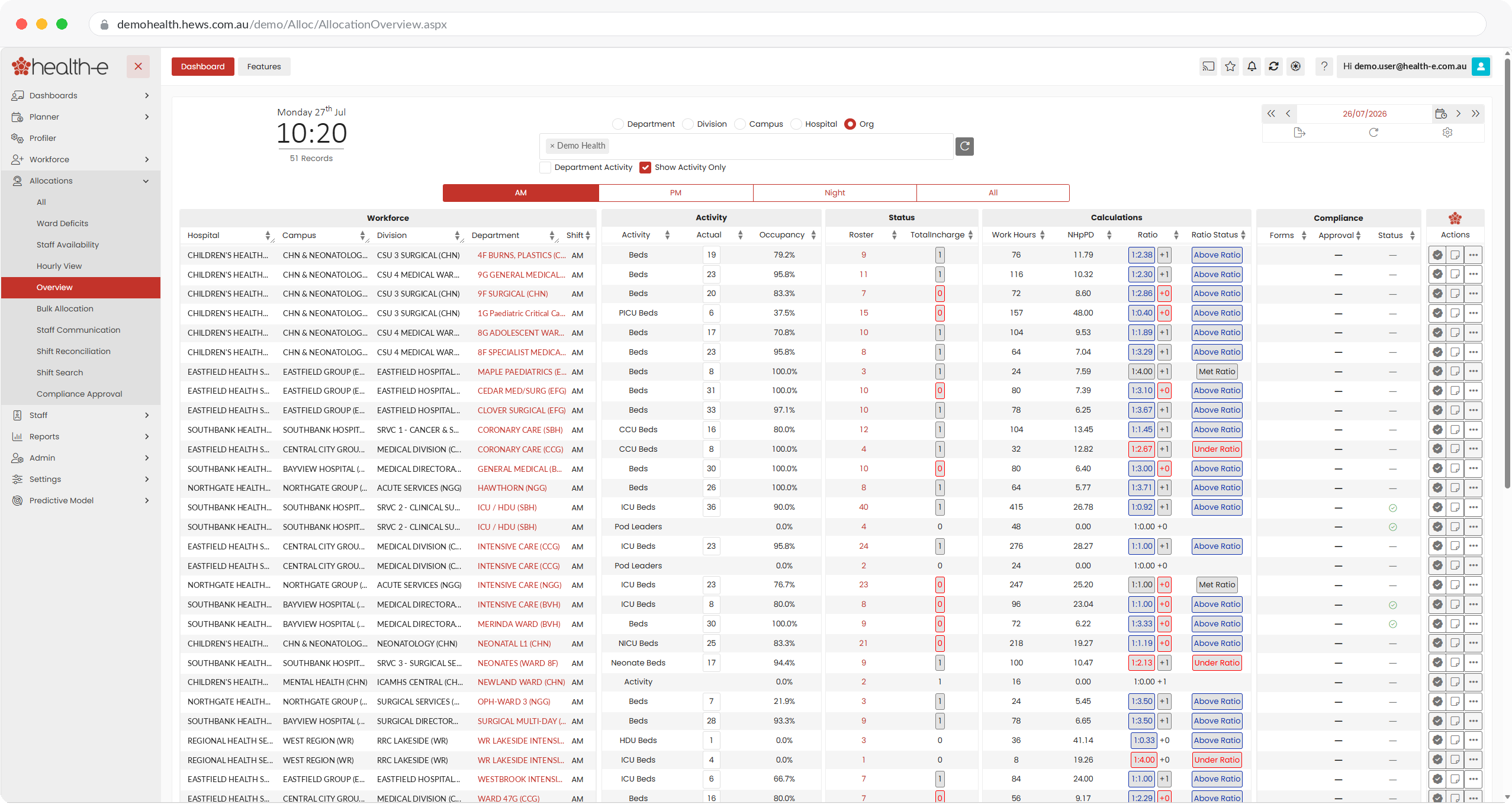

A rostering system fills shifts. Workforce planning decides how many.
Health-e is not a rostering system and does not replace one. It sits above payroll, HR, rostering and finance, and turns them into FTE and dollar budgets an executive can sign off.

In brief
Two different jobs, one workforce
A rostering system operates the workforce. A workforce planning platform governs it.
A rostering system such as Allocate (RLDatix HealthRoster), RosterOn, UKG or Optima builds and publishes rosters, fills shifts, manages leave and feeds payroll. It answers the question: who is working this shift, and is the roster compliant?
A workforce planning platform such as Health-e Workforce Solutions, used by Australian and New Zealand public health services, defines the FTE and dollar establishment for every cost centre, models what changes before budget is committed, and reports actual against plan to finance and the executive. It answers a different question: how many staff should this unit have, what does that cost, and is that what we are actually running?
Health-e is not a rostering system and does not replace one. It reads the roster alongside payroll, HR and finance data, reconciles the four to one trusted FTE and cost definition, and shows the gap between what was planned, what was rostered and what was paid.
Side by side
What each one is built to do
| Question | Rostering system | Health‑e workforce planning platform |
|---|---|---|
| Core job | Build and publish rosters, fill shifts, record attendance, feed payroll | Define, model, budget and monitor the workforce establishment |
| Time horizon | Days to weeks: the roster period | A budget year and the plans beyond it, with live actuals tracked against them |
| Unit of work | Shifts and people | FTE and dollars by cost centre, classification and engagement type |
| Primary users | Nurse unit managers, roster clerks, staff | CNO, CFO, workforce and finance teams, the executive |
| Data it owns | The roster, leave, timesheets | One reconciled definition of FTE and cost across payroll, HR, rostering and finance |
| The question it answers | Who is working this shift, and is the roster compliant? | How big should the workforce be, what does it cost, and are we running it that way? |
| Enterprise agreements | Applies award rules when building shifts | Costs the agreement across the whole establishment: penalties, allowances, leave relief, backfill |
| Agency and bank | Books agency or bank staff to fill a gap | Shows where agency use is structural and what permanent establishment removes it; Allocations matches your own available staff to vacancies before agency is booked |
| Budget | Not its job | GL-linked FTE and dollar budgets finance can approve |
| A new hospital with no roster history | Cannot start until there is a roster to build | Models the workforce from demand, service profile and ratios before the building opens |
| Replaces the other? | No | No. Health-e integrates with your rostering system and reads from it |
Rostering systems named are the ones Health-e integrates with today: Allocate (RLDatix HealthRoster), RosterOn, UKG (Kronos) and Optima. Other systems connect by file extract.
How they fit together
Rostering is an input. Planning is the layer above it.
Rosters are built close to the service, by people who know the clinical requirement intimately. Payroll classifies what the roster produces. Budget describes what finance expected. In most health services the three never quite meet.
01 · Keep rostering where it is
Nothing changes for managers
Nurse unit managers keep building rosters in the system they already use. Health-e does not replace the roster, the leave rules or the payroll feed.
02 · Reconcile four sources
One FTE and one cost, agreed by everyone
Health-e takes the roster feed alongside payroll, HR and finance, and reconciles them to a single FTE and dollar definition by cost centre. Finance and nursing stop arguing about whose number is right.
03 · Plan, then monitor
Budget it, model it, track it
Build the annual establishment and budget, model what a new ward, ratio or agreement changes before committing, then watch rostered and paid actuals against the plan every pay period.
You cannot budget your way out of a roster that does not add up. You also cannot roster your way out of an establishment that was never costed.
Which one do you need
It depends on the question you are trying to answer
You need a rostering system if
- Managers are still rostering in spreadsheets or on paper
- You want self-rostering, leave requests and shift-level award checks
- Payroll needs a clean timesheet feed
- The problem is filling next fortnight, not funding next year
Health-e works with the rostering system you choose. See the payroll, HR, rostering and finance systems we integrate with.
You need a workforce planning platform if
- Finance and nursing cannot agree on how many FTE you actually have
- Agency spend keeps rising and nobody can show where it is structural
- The annual workforce budget takes months and still gets challenged
- You are opening a new hospital, ward or service with no payroll history
- A new enterprise agreement or ratio needs costing before it is signed
This is what Health-e does. Start with Modelling, Allocations or Advisory, or get a Diagnostic on your own data first.
What the planning layer produced
Results from health services that run both
69%
Mercy Health · agency FTE down since 2023
Rostering kept filling the shifts. Health-e Allocations changed where the fill came from, so total cover held while agency FTE fell.
Since 2013
Austin Health · nursing FTE budget approved every year
An annual budget built with finance and nursing for every cost centre, then used for monitoring and recruitment targets through the year.
248
Latrobe Regional Health · additional FTE modelled
The workforce for a 49.8% capacity expansion, modelled before the roster for it existed.
The figures and how each was measured are in the customer stories.
Frequently asked questions
Rostering, workforce planning and where Health‑e sits
Is Health‑e Workforce Solutions a rostering system?
No. Health-e is a workforce planning platform. It does not build rosters, approve leave or manage shift swaps. It reads the roster from your rostering system, alongside payroll, HR and finance data, and uses all four to define, budget, model and monitor the workforce establishment.
Do we need to replace our rostering system to use Health‑e?
No. Health-e integrates with Allocate (RLDatix HealthRoster), RosterOn, UKG (Kronos) and Optima, and connects to other rostering systems by file extract. Managers keep rostering in the tool they already use.
What is the difference between workforce planning software and workforce management software?
Workforce planning software is strategic and financial: the FTE and dollar establishment by cost centre, scenario modelling, budgeting and monitoring actuals against plan over a budget year or longer. Workforce management software is operational: rostering, time and attendance, leave and the payroll feed, working in shifts over days and weeks. Health-e is the first kind.
Can Health‑e tell us whether a roster is affordable?
Yes. Health-e costs rostered practice against the enterprise agreement and the approved budget for each cost centre, so you can see whether the roster as built is within the FTE and dollar establishment, and where penalties, allowances, overtime and agency are pushing it over.
We already have the data in Excel and Power BI. Is that not workforce planning?
It is reporting. Spreadsheets and dashboards show what each source system says, but they cannot hold one agreed FTE and dollar definition across payroll, HR, rostering and finance, re-run it each budget cycle, or audit how a number was produced. That reconciled, repeatable definition is what Health-e provides.
Which rostering systems does Health‑e integrate with?
Allocate (RLDatix HealthRoster), RosterOn, UKG (Kronos) and Optima today. Whether a system has an API does not matter: Health-e works with your team to build the connection or use an existing extract.
Find out what your roster is actually costing
A Health-e Diagnostic uses your own payroll and rostering extract. No change to your rostering system, no integration work to start.