

The nurses we need are already on the payroll


Key points
- The national gap is 70,707 FTE by 2035, with 26,665 FTE in acute care.
- One extra shift a fortnight from nurses under 0.75 FTE closes 20,273 FTE of it. Halving attrition among nurses aged 30 and under closes 13,998.
- Build the budget bottom-up from the staffing model, with finance and nursing in the same room.
- Track contracted versus worked FTE by fraction band and cost centre, and report early-career retention as its own line.
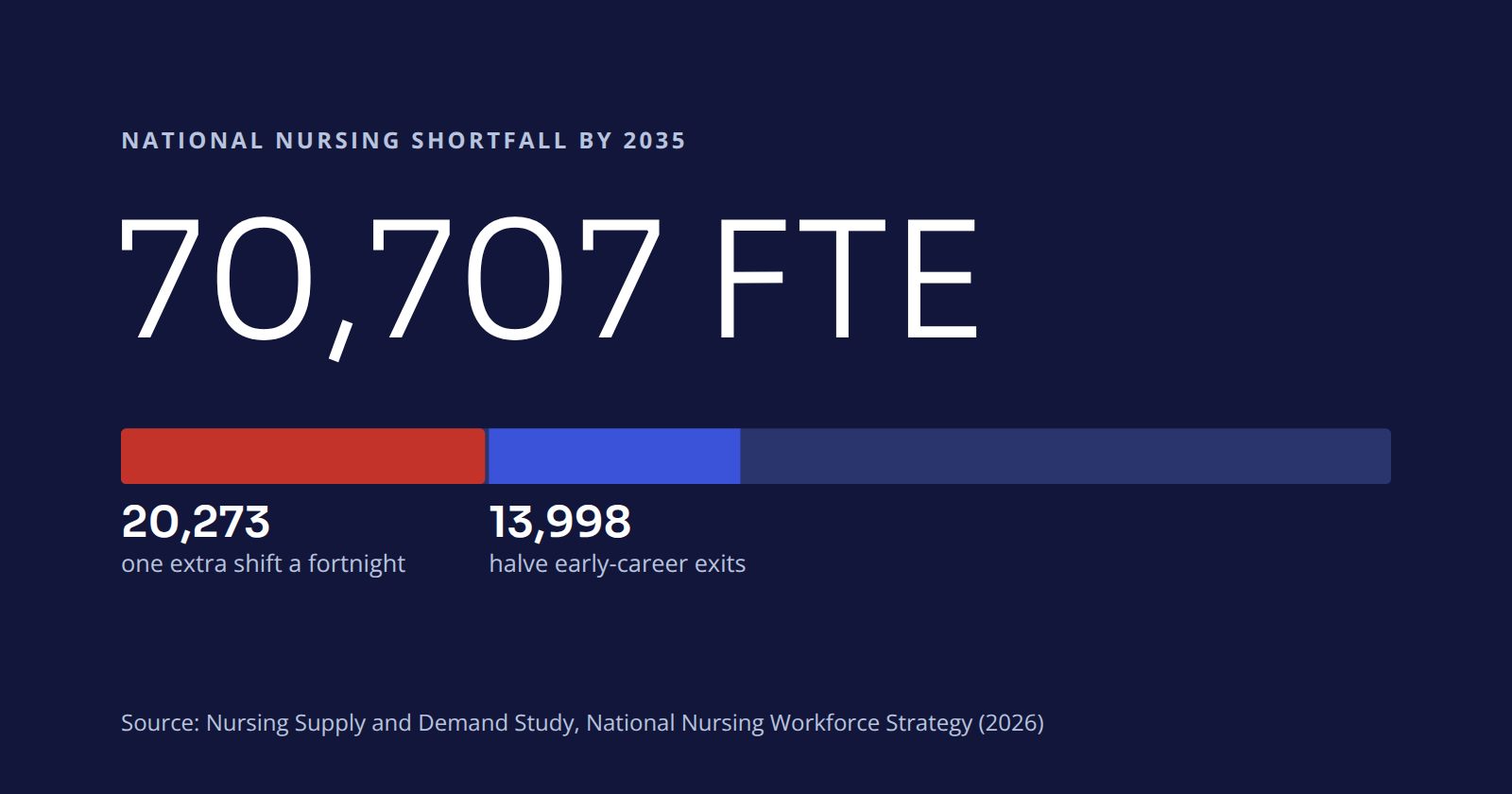
In August, Australia launched its first National Nursing Workforce Strategy, endorsed by every health minister. It rests on a confronting projection: without change, the country will be short 70,707 full-time-equivalent nurses by 2035. Acute care carries the largest share of that gap, at 26,665 FTE.
Those numbers made the headlines. The ones I keep coming back to are buried in the modelling.
The Nursing Supply and Demand Study tested two scenarios. In the first, nurses under 65 working less than 0.75 FTE each pick up one extra shift a fortnight. That alone closes the gap by 20,273 FTE. In the second, nurses aged 30 and under become half as likely to leave. That closes it by 13,998.
Neither scenario needs a single new graduate. Both are about the workforce health services already employ: the hours people are contracted for, the hours they actually work, and whether they stay.
The gap is measured in FTE, not heads
Health services count heads when they recruit and dollars when they report. FTE sits awkwardly between the two, and that is where the shortfall hides.
A ward can be fully recruited on headcount and still be short on hours, because its fraction profile has drifted: more 0.4s and 0.6s, fewer 0.8s and above. Every part-time position carries the same onboarding, education, credentialing and leave management as a full-time one. Then come the agency and overtime used to cover hours nobody is contracted for.
The national modelling confirms what workforce planners see at cost-centre level. Small changes in contracted hours, spread across a large part-time workforce, move the numbers more than most recruitment campaigns.
Record budgets, tight margins
Victoria's 2026–27 Budget took health spending to a record $32 billion, including $3.9 billion in new investment. Health services are still being asked to run at break-even. Both things are true, and some version of them is true in every state.
When money is tight and staff are scarce, the instinct is to manage the two separately. Finance holds the budget, nursing holds the roster, HR holds the vacancies. Each runs its own numbers, and they meet at month-end to explain the variance.
That separation is the problem. Labour is the largest cost a hospital carries. A budget not built from the staffing model is a guess, and a roster not tied to funded FTE is an argument waiting to happen.
What good looks like
The health services doing this well share three habits.
- They build the budget from the bottom up. Every cost centre, from the agreed staffing model and the enterprise agreement rules that drive it, with finance and nursing in the same room.
- They track FTE through the year, not just dollars. Contracted versus worked, by fraction band and cost centre. That turns “one more shift” from a slogan into a specific conversation: which wards, which people, how many hours.
- They watch early-career staff as a distinct group. If retaining nurses under 30 is worth almost 14,000 FTE nationally, it deserves a line on the monthly report locally.
Planning is the lever we control
No health service can fix national supply alone. Training pipelines, migration settings and scope-of-practice reform sit with governments, and the new strategy rightly takes them on.
What every health service controls is how well it understands and uses the workforce it already has. The strategy's own evidence says a large share of the answer sits there. The question for executives is not whether there is a shortage. It is whether they can see, ward by ward, how much of it is theirs to close.
Start with a workforce diagnostic