

A new hospital is a workforce plan with a building attached


Key points
- Unit size, layout, single rooms and ratio classification set staffing for the life of the building.
- A replacement hospital and a greenfield hospital are different planning problems.
- A good plan covers the model of care in FTE, the ramp-up, supply, budget and a regular refresh.
- Bring workforce modelling into design while layout decisions can still change.
One of Victoria’s largest ever health infrastructure projects, the new Footscray Hospital, opened on 18 February 2026. Before the first patients were moved across, more than 4,500 staff had completed 22,000 hours of training, and 200 specialist staff had run 26 clinical simulation exercises. That is what operational readiness looks like from the outside.
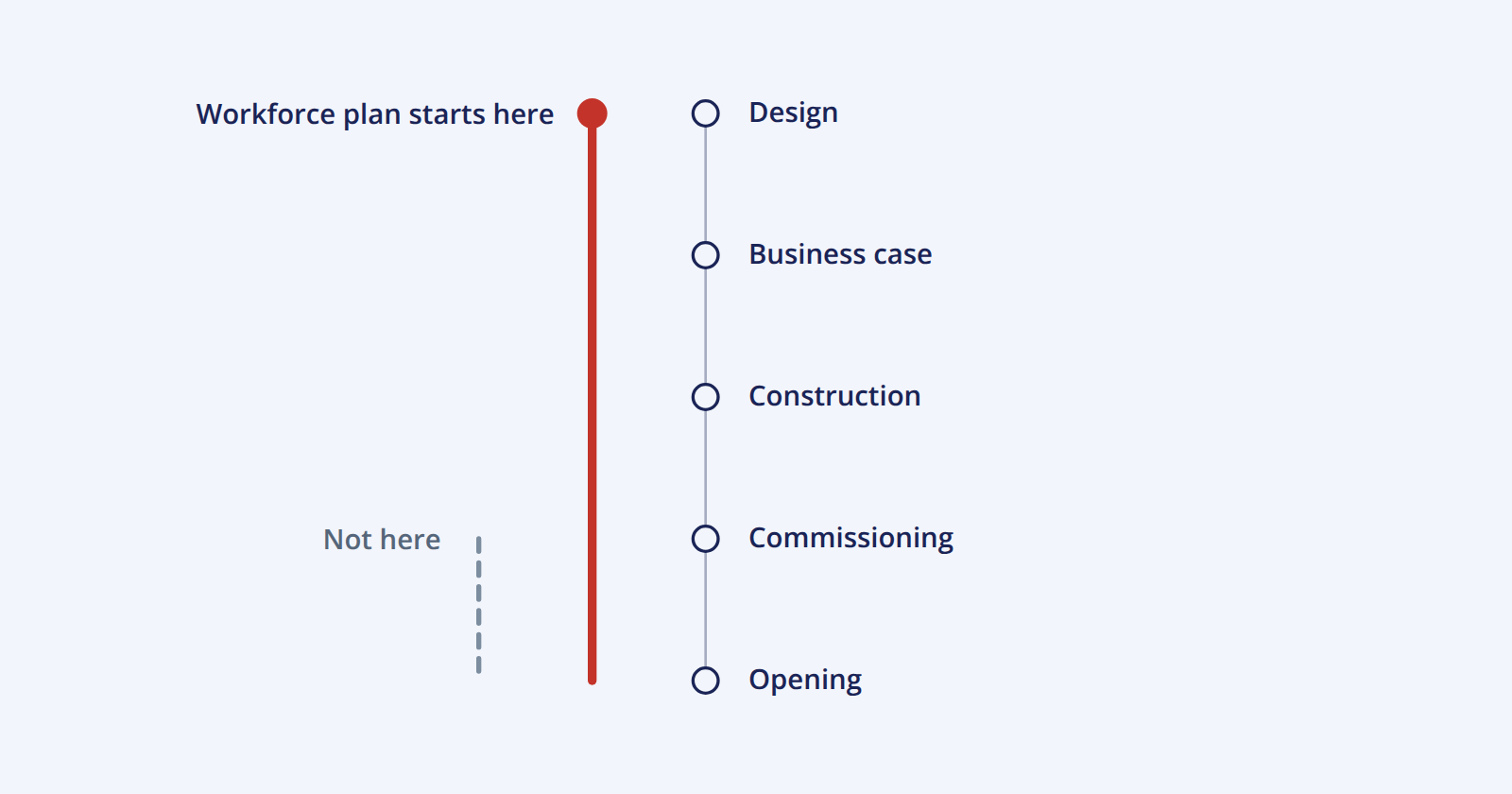
What you don't see is the workforce plan underneath it. It starts long before the training calendar, and it decides more about the hospital's next 30 years than the facade does.
The pipeline is long, and the workforce is the hard part
The next one in Melbourne's west is already under way. The new Melton Hospital is due for completion in 2029 with at least 274 beds. The government expects it to employ 3,975 people on site in its first full year of operation.
That hospital will open into a labour market the national nursing modelling expects to be 26,665 FTE short in acute care by 2035. It will recruit in a growth corridor, against neighbouring services trying to fill the same roles. Building it is a solved problem. Staffing it is not.
Footscray was a replacement: an existing workforce moving to a new site. Melton is greenfield, with no existing workforce to move. Those are different planning problems, and they need different plans.
Design decisions are staffing decisions
The most expensive workforce choices are made in design workshops, often by people who will never see the roster.
- Unit size and layout set how many nurses a ward needs on each shift. A layout that splits a 32-bed unit into awkward pods can add staff on every shift for the life of the building.
- Single rooms improve infection control and privacy. They also change line of sight, observation and patient-to-staff ratios in practice, not just on paper.
- Legislated and enterprise-agreement ratios, such as those under Victoria's Safe Patient Care Act, apply by ward type and shift. Classify a unit one way in the design brief and another way at opening, and the staffing model changes with it.
None of these is a reason to design for the roster. Each is a reason to have someone modelling the roster while the design is still being argued over.
What a good new-build workforce plan covers
- The model of care, translated into FTE. Unit by unit and role by role, shift by shift, then annualised for leave, education, backfill and supervision. Every assumption written down.
- The ramp-up. Beds rarely open all at once. The plan should show how staffing grows with commissioned capacity, what dual running of old and new sites costs, and how much paid training time readiness needs.
- The supply. Where the people come from: transfers, graduates, internal promotion, recruitment, international candidates. Then whether that is realistic in the local market.
- The budget. The operating cost of the workforce plan, reconciled to the funding model, so the executive is not discovering the gap in the first year of operation.
- The refresh. Business cases are often written five or more years before opening. Models of care, agreements and demand all move in that time. A workforce plan that isn't revisited is a historical document.
Start earlier than feels necessary
The health services that open well treat workforce planning as part of the capital project, not something that follows it. They bring workforce modelling into design, test the staffing implications of layout decisions while they can still change, and keep refining the model until the doors open.
The ribbon-cutting is the end of the workforce plan's first chapter. For the patients and staff who arrive the next morning, it had better have been a good one.
Start with a workforce diagnostic