

AI can't plan a workforce your systems can't describe


Key points
- Workforce data sits in at least four systems, and none of them can answer the executive's question alone.
- Most failures are definitional: what FTE means, drifting cost centres, shift codes and missing keys.
- Agree definitions once, keep systems connected with reliable extracts, and reconcile to the general ledger.
- Govern workforce data as personal data before any AI model touches it.
AI has moved from conference slides to hospital wards. Health services are piloting AI rostering and ambient scribes. This year the Victorian Department of Health issued statewide guidance on safe AI use, setting requirements that must be met before a tool goes live. The national AI in healthcare policy roadmap released in July urges services to move beyond isolated pilots to deployment at scale.
All of that is welcome. But the question that rarely comes up in a demo is the one that decides whether the tool works: where does the data come from?
Four systems, four versions of the truth
In a typical public health service, the workforce lives in at least four places.
- Payroll and HR know what each person was paid and what they are contracted for.
- Rostering knows who was planned to work, and usually who actually did.
- Finance knows which cost centre carried the cost and what was budgeted.
- Patient administration knows the activity: admissions, bed days, presentations.
Each system was built to do its own job, and most do it well. None of them, on its own, can answer the question executives actually ask: was this ward staffed to its model last month, what did that cost against budget, and why?
Answering that means joining the four. That is where most of the effort, and most of the errors, sit.
Where it breaks
The failures are rarely technical. They are definitional.
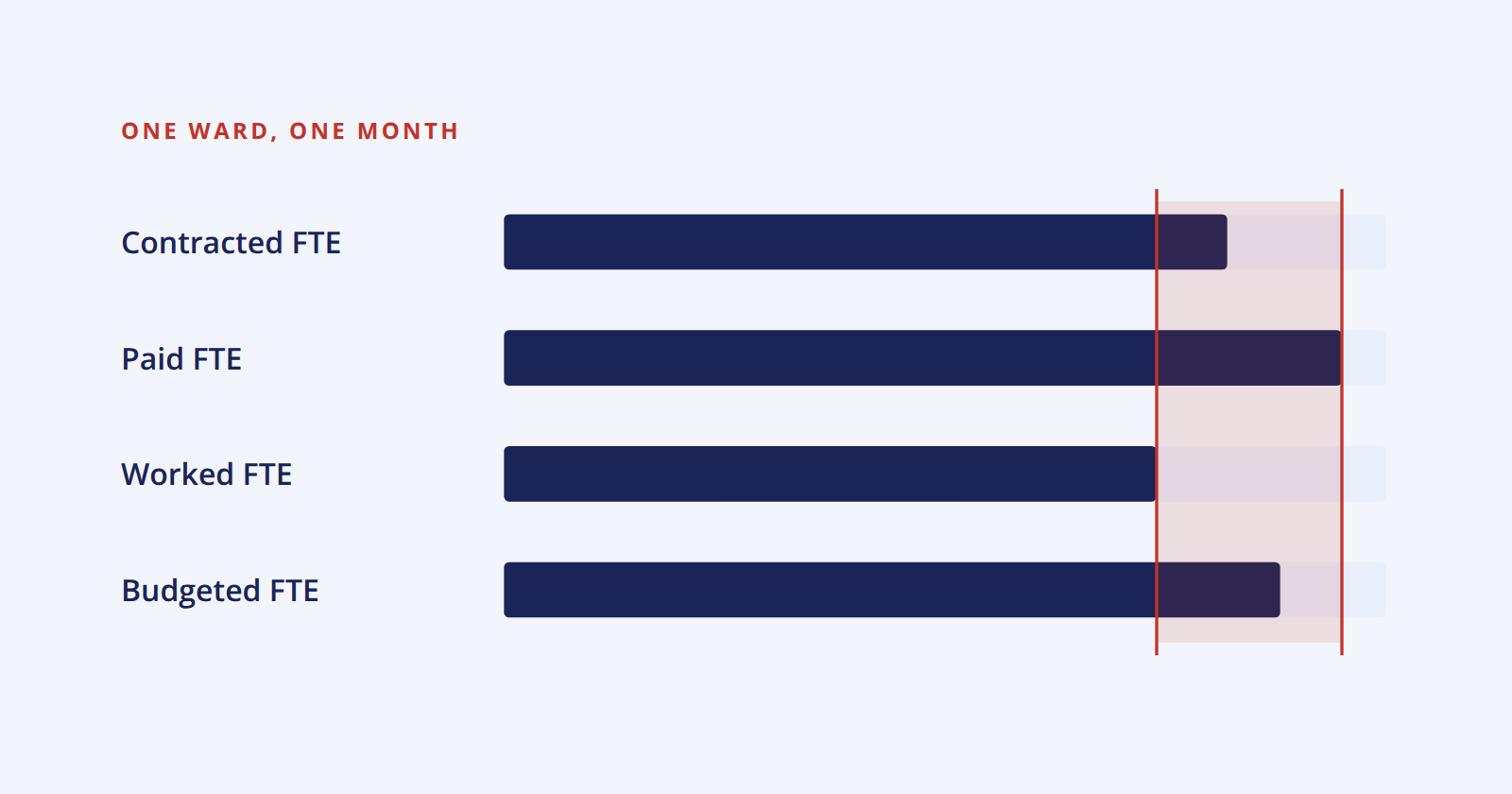
- FTE means different things to different people. Contracted, paid and worked FTE can differ materially on the same ward once leave, education and overtime are counted.
- Cost centres drift. A restructure moves a team, payroll updates, finance updates later, the roster system never does.
- Shift codes don't map cleanly to entitlements. A roster code that means one thing on a medical ward means another in ED, and the enterprise agreement treats them differently again.
- Activity and workforce rarely share a key. Linking bed days to the nursing hours that delivered them takes deliberate work.
Put an AI model on top of that and you get confident answers that are wrong, faster. A forecast built on the wrong FTE definition is still the wrong forecast. It just looks better.
Fix the plumbing first
The health services that get value from analytics, AI or otherwise, tend to do three unglamorous things first.
- Agree the definitions once. Contracted, paid and worked FTE. Productive and non-productive hours. Write them down and hold every report to them.
- Connect the systems and keep them connected. Whether a source has a modern API matters less than people think. A reliable scheduled file extract beats a clever integration that breaks after the next upgrade. The aim is a monthly feed, not an annual data-gathering exercise.
- Reconcile to the general ledger. If workforce numbers don't tie back to what finance reports, nobody in the executive will trust a prediction built on them. Nor should they.
Govern it like the sensitive data it is
Workforce data is personal data: pay, leave, hours, sometimes health. Before any AI touches it, a health service should know where it is stored, which models see it, and whether it leaves the country. That matters as much as clinical data governance, and it is easier to design in than retrofit.
There is a practical risk too. When staff can't get answers through approved systems, some will paste a roster into a public AI tool to get one. Good internal data and sensible tools are the best defence against that.
The boring work is the AI strategy
AI will be genuinely useful in workforce planning: spotting leave patterns, forecasting demand, testing roster options in minutes rather than weeks. None of that is far off.
But the value will go to health services whose data can support it. The ones who get the most from AI in 2027 will be the ones who did the data work in 2026.
Start with a workforce diagnostic