
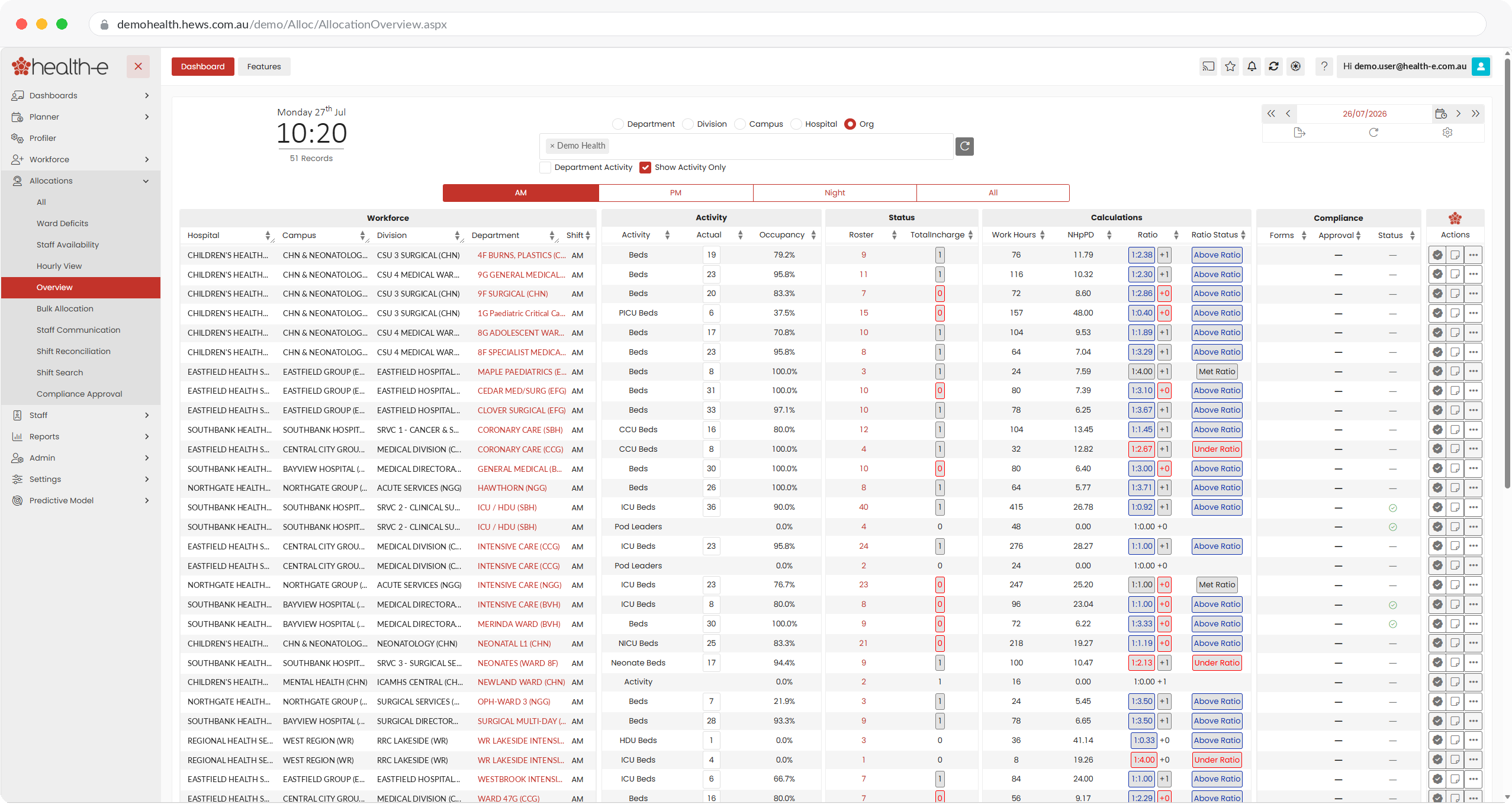

Spreadsheets show what each system says. Health‑e makes them agree.
Excel and Power BI are where most hospital workforce planning happens today. Health-e does not replace the analysts who use them. It gives them one reconciled FTE and dollar definition to work from.

In brief
Reporting is not the same as planning
Excel and Power BI report on workforce data. Health-e governs it.
A spreadsheet or BI dashboard shows what each source system says: payroll reports one FTE, HR another, the roster a third and the general ledger a fourth. Each is right by its own definition. Reconciling them is manual work, done by the finance team or equivalent, rebuilt every budget round, and hard to audit six months later.
Health-e Workforce Solutions, used by Australian and New Zealand public health services, holds one governed FTE and dollar definition across payroll, HR, rostering and finance, applies the enterprise agreement to it, and re-runs it every pay period and every budget cycle. Finance, nursing and the executive work from the same number and can see how it was produced.
Health-e does not replace Excel or Power BI. Analysts still export, chart and present. What changes is that they start from a reconciled, repeatable base instead of building one.
Side by side
Where the two approaches differ
| Question | Excel and Power BI | Health‑e workforce planning platform |
|---|---|---|
| Where the FTE definition lives | In each analyst's workbook, and in each analyst's head | In the platform: one governed definition per cost centre |
| Reconciling payroll, HR, roster and GL | Manual, rebuilt each budget cycle | Automated integration, reconciled every pay period |
| Enterprise agreement costing | Hard-coded formulas that drift as agreements change | Applied as rules across the whole establishment: penalties, allowances, leave relief, backfill |
| Scenario modelling | Copy the workbook, change the inputs, hope nothing breaks | Build and compare scenarios side by side before committing budget |
| Audit trail | The analyst who built it | Every figure traces back to its source extract and the rule applied, and user activity is tracked in the platform |
| Who can use it | The people who built the model | Finance, nursing, workforce and the executive, each with their own view |
| Key-person risk | High. The model leaves when the analyst does | Low. The definition, the rules and the history stay in the platform |
| Rebuilding the annual budget | Weeks to months, from a fresh extract | Re-run on the governed model |
| Monitoring actuals against plan | Monthly, if someone re-runs the workbook | Every pay period, rostered and paid against the approved establishment |
| A new hospital with no history | Assumptions in a spreadsheet nobody can validate | Modelled from demand and service profile, with a recruitment target for every role |
| Replaces the other? | No | No. Health-e gives Excel and Power BI a trusted base to report from |
Platform capabilities described are the Health-e Modelling and Insights modules.
How they fit together
The model was never the problem. The inputs were.
Most hospital workforce budgets are built by an analyst or a team in workbooks that have grown for years. The formulas are usually right. The four systems they draw on never agree, so the workbook has to pick.
01 · Four systems, four answers
Payroll, HR, roster and ledger each count FTE differently
Leave relief, part-time extra, pool and agency sit in different places in each system. A spreadsheet has to choose one view and quietly ignore the rest.
02 · Rebuilt, not re-run
Every budget round starts from scratch
Extracts change, columns move, someone leaves. The reconciliation is done again in spreadsheets, and last year's logic is rarely the same as this year's.
03 · Trust lives with a person
The executive signs off a number nobody else can reproduce
When finance challenges the figure, the answer is to open the workbook. Health-e answers with the source extract and the rule that was applied.
A spreadsheet can hold a workforce model. It cannot hold the agreement about what the numbers mean.
Which one do you need
When a spreadsheet is enough, and when it is not
Excel and Power BI are enough if
- One site, one cost centre group, a model with a clear owner
- The budget is approved without challenge each year
- No new build, ratio change or enterprise agreement on the horizon
- Nobody needs to see how a number was produced a year later
Not sure which you are? A Health-e Diagnostic reads your own payroll and rostering extract and shows where the systems disagree.
You need Health-e if
- Finance and nursing produce different FTE numbers from different extracts
- The annual budget takes months to rebuild and still gets challenged
- You need to compare scenarios, not copy workbooks
- A new hospital, ward or agreement needs costing with no history to copy from
This is what Health-e Modelling and Insights do. See how Health-e connects to payroll, HR, rostering and finance.
What the planning layer produced
Results from health services that run both
69%
Mercy Health · agency FTE down since 2023
Measured from the same reconciled data every pay period, so the reduction is one everyone can check, not one workbook's view.
248
Latrobe Regional Health · additional FTE modelled
For a 49.8% capacity expansion, modelled from demand and service profile with a recruitment target for every role, not a spreadsheet assumption.
The figures and how each was measured are in the customer stories.
Frequently asked questions
Excel, Power BI and where Health‑e fits
Does Health‑e replace Excel and Power BI?
No. Analysts keep using Excel and Power BI to explore, chart and present. Health-e replaces the manual reconciliation underneath them: it holds one governed FTE and dollar definition across payroll, HR, rostering and finance, so every spreadsheet and dashboard starts from the same trusted base.
How does Health‑e Modelling differ from a spreadsheet budget model?
Spreadsheets and BI tools require manual data preparation, individual expertise and do not enforce consistent metric definitions. Health-e Modelling automates data integration from payroll and GL systems, provides governed budget templates, and lets you run multiple scenarios without rebuilding from scratch each time.
Our analyst has built a model that works. Why change it?
Because the model is only as durable as the person. When the analyst leaves, or when finance challenges a figure a year later, the workbook cannot explain itself. Health-e keeps the definition, the rules and the history in the platform, where any authorised user can see how a number was produced.
Can Health‑e cost our enterprise agreement the way our spreadsheet does?
Yes. Health-e costs rostered practice against the enterprise agreement across the whole establishment: penalties, allowances, leave relief and backfill, applied as rules rather than as formulas copied between workbooks. When the agreement changes, the rule changes once.
See what your spreadsheet is missing
A Health-e Diagnostic reads your own payroll and rostering extract and shows where the four systems disagree. No system change to start.