



What was the challenge?
Mercy Health's nursing and midwifery workforce at Mercy Hospital for Women and Werribee Mercy Hospital relied on supplementary staff to fill roster gaps, and a large share of that was agency. Requests, fills and costs sat in different places, so nobody could see the whole picture of who was covering what.
Mercy wanted one place to request, fill and track every supplementary shift across both hospitals, connected to its payroll, rosters and leave, and it wanted to fill more of those shifts from its own people.
What did Health-e do?
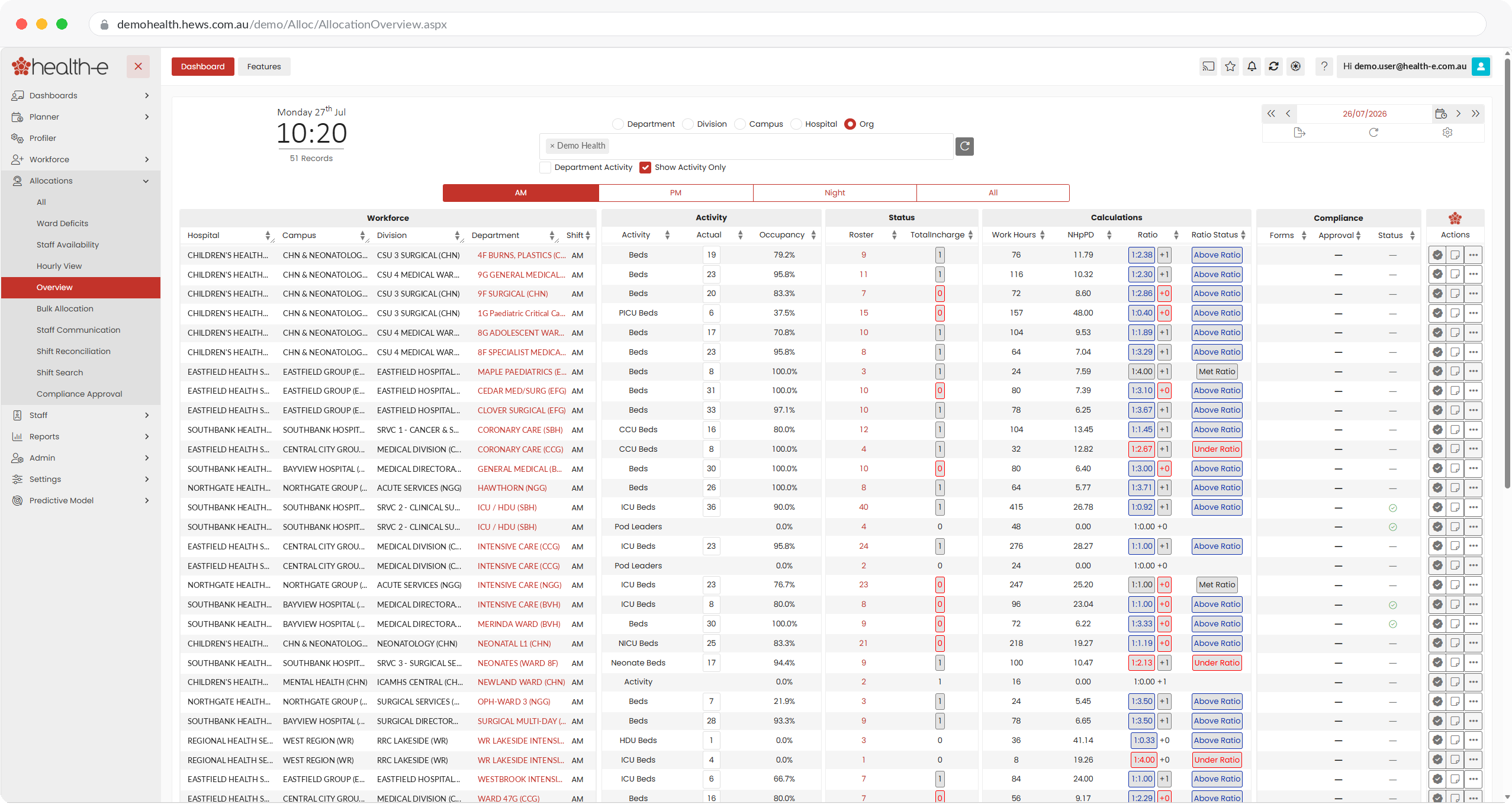
Health-e brought Mercy's Active Directory, payroll, leave, masterfile, agency, organisation structure, award and budget data into one platform, with rostering and activity feeds following. Smart Allocations went live on 8 February 2023 for nursing, midwifery and support at both hospitals. The central allocations team, unit managers, casual staff and accounts payable all work in the same system; casual staff have an app and automated SMS shift offers.
Since go-live Mercy has kept extending the system across its sites, and is now rolling it out across its mental health services. From late 2024 Mercy's own pool of nurses began taking a growing share of shifts, and because every shift already ran through Smart Allocations, pool staff could be offered work ahead of agency from the start.
Alongside allocations, Mercy builds its nursing budget on Health-e each year, cost centre by cost centre with its finance and nursing teams, the same annual process Health-e runs with Austin Health, Western Health and other clients.
What were the results?
In the first month after go-live, Smart Allocations confirmed 3,009 shifts, 936 user accounts were activated and 760 staff had the casual bank app. Since then more than 167,000 shifts have been filled through the system.
Total supplementary cover has stayed at about 160 FTE a month. What changed is who provides it. Agency averaged 44 FTE a month through 2023 and 50 through 2024; in 2026 it is 14. Over the same period Mercy's own pool grew from under 2 FTE a month to 37, and bank held at around 80. Agency's share of supplementary cover fell from 26% in 2023 to 9% in 2026. In shift terms, agency went from about 880 shifts a month in 2024 to about 270 in 2026, while pool shifts rose to about 700 a month.
Every one of those numbers comes from the same system Mercy uses to fill the shifts, broken down by hospital and department.
What does this make possible?
When every supplementary shift runs through one system, the mix becomes a lever rather than a surprise. Mercy could see agency, bank and pool by department each month, build a pool to take the work agency was doing, and watch it happen in the same reports.
Three and a half years in, the system is still being extended, now to mental health, and the annual nursing budget is built on the same data that fills the shifts.