



What was the challenge?
A nursing FTE budget for more than 3,800 staff and around 2,600 FTE across 145 cost centres normally takes months of spreadsheets passing between finance and the wards, and ends with a number many managers never agreed to. Finance then spends the year defending it, and nobody is certain the budgeted staffing actually meets the enterprise agreement or the legislated ratios.
Austin wanted a budget every cost centre manager helped set, built from one source with finance, compliant by construction, approved quickly, and used afterwards to monitor performance, set recruitment and fill shifts.
What did Health-e do?
Every year since 2013 Health-e has run the nursing budget build with Austin's finance and nursing teams. Every cost centre is profiled from its own roster: the staffing pattern is modelled shift by shift, then costed with annual leave, sick leave, study leave and graduate leave built in. Each profile is checked against the Nurses and Midwives (Victorian Public Sector) Enterprise Agreement and the Safe Patient Care Act ratios before the manager reviews it with finance and it is locked. No cost centre is budgeted without its manager in the room, and none is approved without passing the compliance check.
Because the profiles come from live roster and payroll data already in Health-e, there is no data-gathering phase and no reconciliation of competing spreadsheets. The time goes into manager review and sign-off. Cost centres that don't reconcile are held and worked through with finance rather than forced to a number.
Once approved, the profiles stay live. Actual payroll loads against them each fortnight, so each division and department sees budgeted versus actual FTE, leave and supplementary use through the year. The gap between approved FTE and permanent staff in each cost centre becomes its recruitment target, and allocations fills the day-to-day shortfall from the same platform.
Because every profile is costed under the current agreement, the same profiles can be re-costed under a new one. When a new EBA has been negotiated, Austin has tested the proposed terms against its actual rosters in Health-e to see the FTE and cost impact by cost centre before the agreement took effect.
What were the results?
The 2027 FY nursing FTE budget, 145 cost centres and around 2,600 FTE across seven divisions, went from first profile to approved budget in two weeks. A conventional FTE budget process in a health service of this size runs six weeks to several months, so two weeks is at most a third of the time. Every profile was reviewed with its manager and checked against the EBA and Safe Patient Care Act ratios before approval. Austin has built its nursing budget this way every year since 2013.
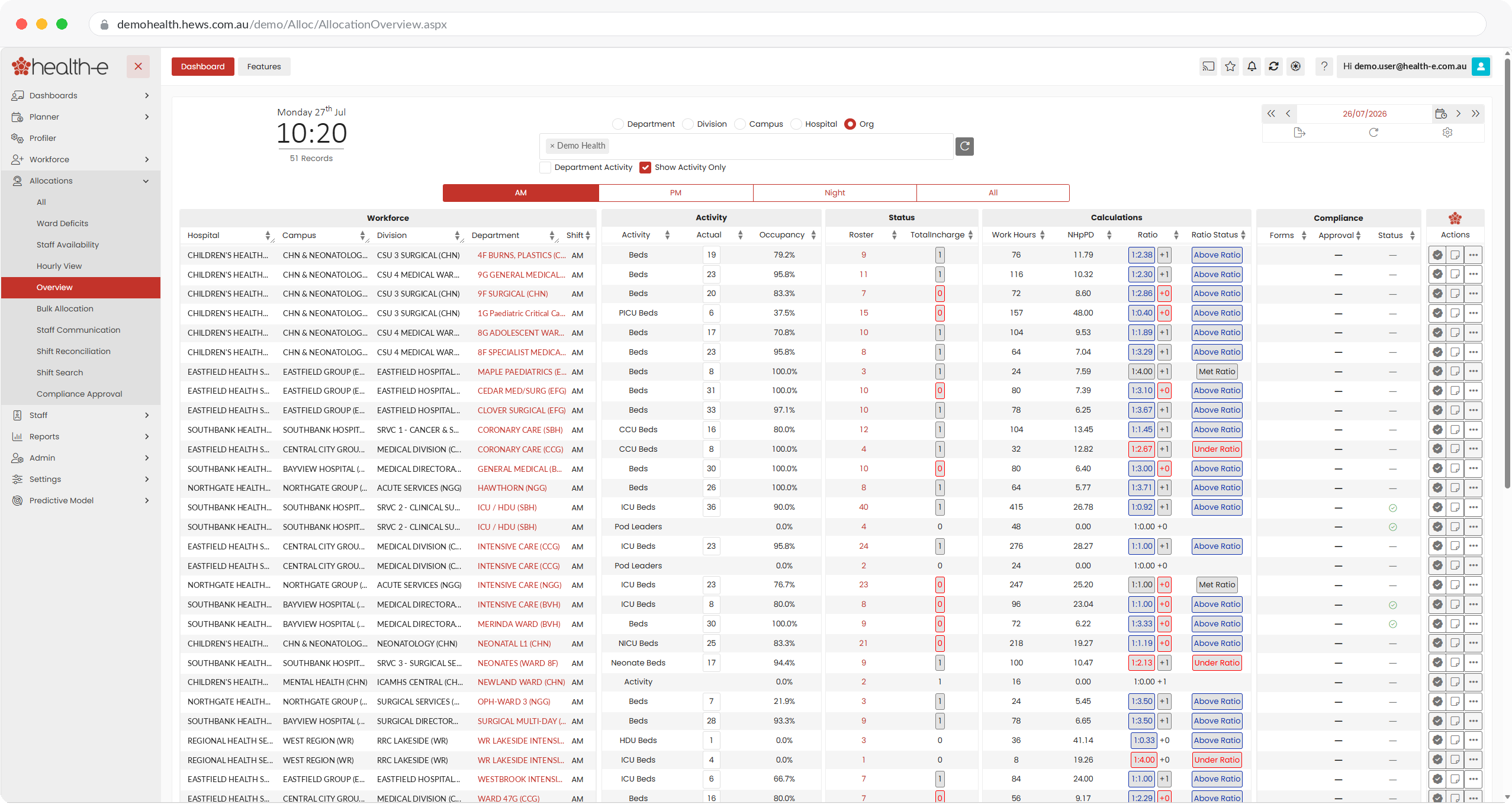
Through 2024-25 the same budget drove performance monitoring across about 70 department-level views of shortfall, leave and supplementary staff, and set recruitment targets by cost centre. Allocations confirmed 37,461 shifts against it, 82% of those requested, with 2,921 staff logging availability and 7,629 shifts booked by automated SMS.
When new enterprise agreement terms were on the table, Austin re-costed its existing profiles under the proposed terms in Health-e, giving finance and nursing a cost-centre-level view of the impact before it landed in the budget.
What does this make possible?
A budget approved in weeks rather than months, by the people who run the wards, compliant with the agreement and the ratios before it is signed, and then used three ways: finance monitors to it, nursing recruits to it, allocations fills against it.
Thirteen years in, each year starts from profiles every manager has already agreed, so the time goes into what has changed, not into relitigating the number.
And when the agreement itself changes, Austin can see what it means before it has to budget for it.