

A report describes one year. A dynamic model is re-run every year.
Workforce consulting usually ends with a PDF. Health-e Advisory ends with a model that stays in the platform, connected to your data and re-run each budget cycle.

In brief
Same questions, different shelf life
A consulting report answers the workforce question once. A dynamic model keeps answering it.
A point-in-time workforce review takes an extract, applies a method and produces a report: the establishment, the gap, the recommended FTE. It is accurate on the day it is delivered. Twelve months later the roster, the enterprise agreement and the activity have all moved, and the report has not.
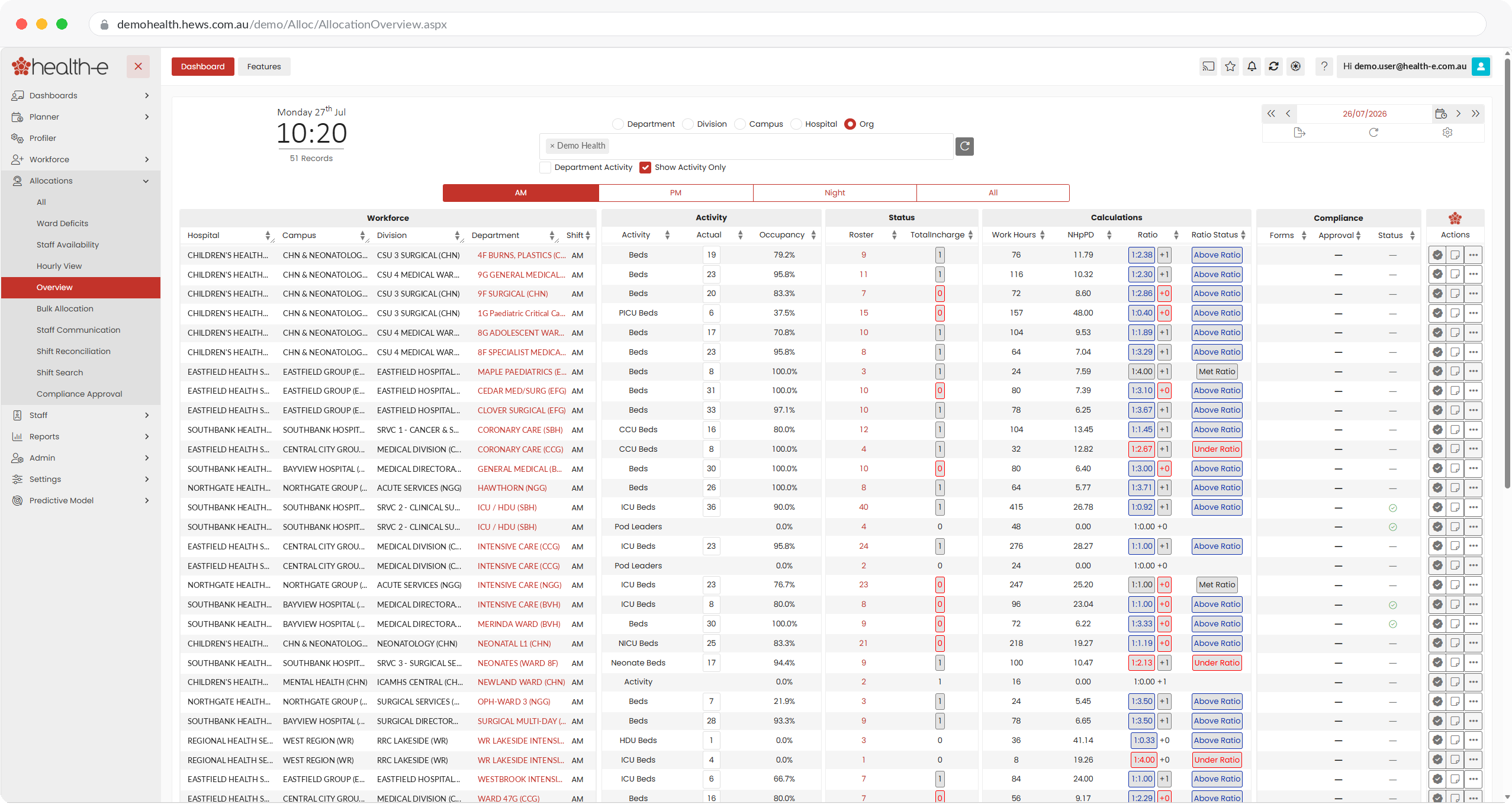
Health-e Workforce Solutions delivers the same analysis as a model inside its platform, connected to payroll, HR, rostering and finance. Annualised budgets, greenfield hospital builds and workforce optimisation are built by the Health-e advisory team, then re-run by the health service with its own data every budget cycle, with ongoing Health-e support.
The difference is what you are left holding at the end: a model you keep running, not a document you file.
Side by side
What you get, and what you keep
| Question | Point-in-time consulting report | Health‑e Advisory with a dynamic model |
|---|---|---|
| What is delivered | A report and a recommendation | A model in the platform, plus the report and recommendation |
| Data it is built on | One extract, cleaned once | Connected payroll, HR, rostering and finance feeds, reconciled every pay period |
| When it is right | On the delivery date | Every time it is re-run |
| Next budget cycle | Re-engage, re-extract, re-pay | Re-run the model with this year's data |
| Scenarios after delivery | Ask the consultant | Build and compare them yourself in Health-e Modelling |
| Monitoring against the plan | Not included | Rostered and paid actuals against the approved establishment, every pay period |
| When the enterprise agreement changes | A new engagement | Update the rule, re-run the model |
| Knowledge transfer | Slides and a workshop | The method lives in the model your finance and nursing teams use, with ongoing Health-e support |
| A new hospital with no payroll history | A design report | A workforce model that becomes the opening establishment and the recruitment target for every role |
| Defensibility a year on | It was right when it was written | Every figure traces to a source extract and the rule applied |
| Which do you get from Health-e? | The report, if that is all you need | Both. Advisory builds the model; the platform keeps it alive |
Health-e Advisory covers annualised workforce budgets, greenfield hospital builds and workforce optimisation.
How they fit together
The analysis holds. The inputs move.
Rosters change every fortnight. Agreements change every few years. Activity moves with every season. A report captures one moment in all three, and the moment passes.
01 · Delivered as a model
The engagement ends in the platform, not in a PDF
Health-e advisors build the budget, greenfield model or optimisation inside the platform, costed bottom-up from actual rostered practice, with your finance and nursing teams in the room.
02 · Re-run, not re-bought
Next year's budget starts from this year's model
The health service builds its annual FTE budget for every cost centre on the model each year with its finance and nursing teams, then uses it for monitoring and recruitment targets through the year.
03 · Defensible after the consultant leaves
Every number still traces to its source
When the figure is challenged, the answer is in the platform: the extract it came from, the rule that was applied and the scenario that was chosen.
A report tells you what the workforce looked like. A model tells you what it looks like now.
Which one do you need
When a report is enough, and when it is not
A point-in-time report is enough if
- It is a one-off question: a merger, a due-diligence review, a board paper
- You want an independent opinion and will not need to re-run it
- Nobody will challenge the number a year from now
- There is no annual budget, new build or agreement change coming
Health-e can deliver that too. It will arrive with a model behind it. See Health-e Advisory.
You need a dynamic model if
- The workforce budget has to be built and approved every year
- You are opening a new hospital, ward or service with no payroll history
- An enterprise agreement or ratio change is coming and needs costing
- Finance and nursing need to monitor actuals against the plan, not just read it
- You want the method to outlive the engagement and the consultant
This is how Health-e Advisory is delivered. The model lives in Modelling, or start with a Diagnostic on your own data.
What the planning layer produced
Results from health services that run both
69%
Mercy Health · agency FTE down since 2023
A result that is still being measured every pay period, three years on, because the model that measures it is still running.
The figures and how each was measured are in the customer stories.
Frequently asked questions
Reports, models and how Health‑e Advisory works
Is Health‑e Advisory a consulting service?
Yes. Health-e Advisory builds annualised hospital workforce budgets, models greenfield hospital builds and optimises existing workforces. The difference from a conventional engagement is that the work is delivered as a model inside the Health-e platform, connected to your data, rather than as a report alone.
What happens to the model after the engagement ends?
It stays in the platform with its data, rules and history. The health service re-runs it each budget cycle with current payroll, HR, rostering and finance data, builds new scenarios in Modelling, and monitors rostered and paid actuals against the approved establishment through the year, with ongoing support from Health-e.
Can our own finance and nursing teams re-run the budget?
Yes. The health service builds its annual FTE budget for every cost centre on the model with its own finance and nursing teams. Health-e assists with every annual budget cycle and typically runs the interviews, a one- to three-week process depending on the size of the health service.
How is the workforce costed?
Bottom-up, from actual rostered practice, using real or virtualised staff, with the enterprise agreement applied: penalties, allowances, leave relief and backfill. The result is an FTE and dollar establishment by cost centre that finance can trace and approve.
How do you model a new hospital with no payroll history?
From demand, service profile and ratios rather than from history, costed from rostered practice using virtualised staff. The model becomes the opening establishment and a recruitment target for every role.
Do we still get a report?
Yes. Every engagement produces the written findings and recommendations an executive and board expect. The report is generated from the model, so when the model is re-run the figures in it can be refreshed rather than re-researched.
Ask for the model, not just the report
Start with a Diagnostic on your own payroll and rostering extract, or talk to a health service that has been re-running its model for years.